Static Residential Proxy Ultimate Guide
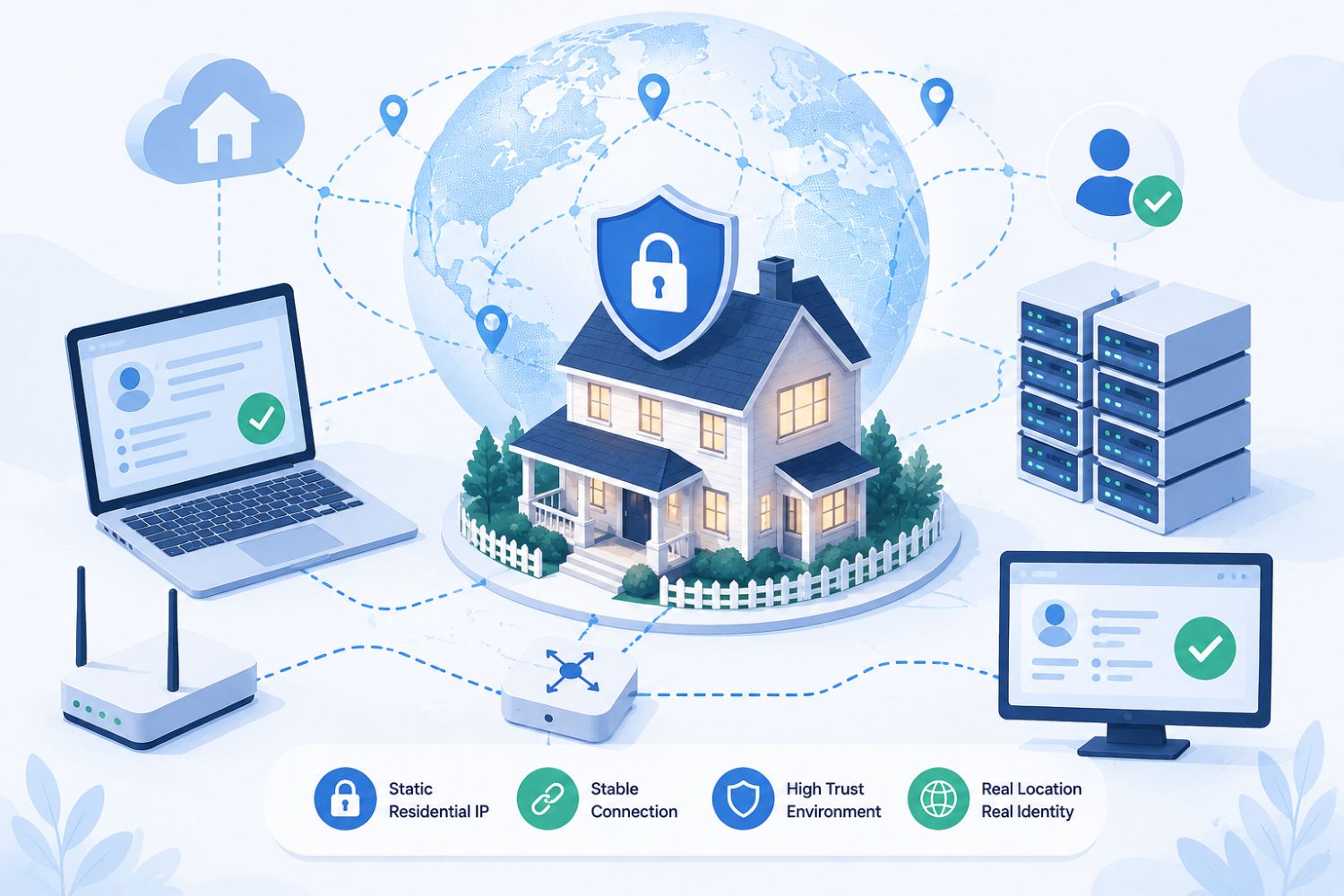
A Static Residential Proxy (also known as a Fixed Residential IP) is a premium network resource that combines the high-speed stability of a datacenter proxy with the elite trust scores of a dynamic residential proxy. Directly assigned by authentic Internet Service Providers (ISPs), it features the signature profile of a genuine consumer home network while remaining permanently fixed and exclusively dedicated to you.
For professional teams managing high-value digital assets—such as cross-border e-commerce storefronts, international social media profiles, and long-session browser automations—static residential proxies serve as the foundational infrastructure for maintaining a stable "digital identity."
Key Takeaways
- Identity Exclusivity: Static residential proxies provide a long-term, unvarying IP address, acting as the baseline defense for building account trust.
- Genuine ISP Signature: Carrying network identifiers (ASNs) identical to standard consumer broadband, these proxies completely remove the风控 (risk control) noise generated by datacenter blocks.
- Precise Scenario Alignment: Static IPs are custom-built for account management, store operations, and high-continuity sessions; use dynamic IPs instead if your workflow requires massive concurrency or highly distributed scraping.
- Fingerprint Synchronization: Premium static lines must be precisely aligned with your browser fingerprints (time zones, languages, WebRTC), or cross-signal checks will still trigger platform alerts.
Why Is Your Account Constantly Facing Risk Restrictions?
Entering mid-2026, the risk control engines of major global platforms (such as Amazon, TikTok, Meta, and X) evaluate incoming connection requests through one primary lens: Environmental Consistency.
Many compliant marketing and operational teams suffer accidental suspensions because their infrastructure inadvertently steps into these two network traps:
- Utilizing Datacenter Proxies: The Autonomous System Number (ASN) of a datacenter IP immediately reveals that the connection originates from a hosting facility or cloud server network. To platform security models, it is highly unnatural for a real human consumer to log into TikTok or manage an active storefront from an AWS or Alibaba Cloud server block. This "non-residential fingerprint" drops the account's baseline trust score instantly.
- Excessive IP Jumping: If a high-value business account repeatedly changes its IP address or switches geographical regions within a few hours, risk engines flag the session as a "fragmented, high-risk identity," triggering automated locking protocols.
This operational friction is precisely why clean, static residential proxies have become a mandatory baseline requirement for cross-border operations.
S
tatic vs. Datacenter vs. Dynamic Residential Proxies: A Deep Selection Blueprint
To help you make the most precise infrastructure decision, we have stripped away rigid table grids to break down the technical characteristics of the three primary proxy types directly:
Static Residential Proxies
- IP Origin & Identity: Authentic consumer-grade broadband directly issued by local Internet Service Providers (ISPs).
- Rotation Mechanism: Permanently fixed and exclusively dedicated to a single user, establishing a highly stable, long-term digital profile.
- Platform Trust Weight: (Elite tier; classified as a trusted, low-risk environment by fraud detection engines).
- Optimal Use Case: Cross-border e-commerce storefront management, international social media account growth, and high-value digital asset maintenance.
- Session Continuity: Flawless. Unlimited session length with zero sudden disconnections, ensuring natural cookie and cache preservation.
Datacenter Proxies
- IP Origin & Identity: Mass-hosted server blocks owned by cloud providers and data centers (e.g., AWS, Alibaba Cloud, Linode).
- Rotation Mechanism: Generally fixed, but highly susceptible to structural block detection due to heavily sequential IP subnet patterns.
- Platform Trust Weight: (Very poor; instantly flagged as machine automated, resulting in continuous CAPTCHA loops or blocks).
- Optimal Use Case: Basic geo-unblocking, high-speed data transiting, and low-sensitivity scraping tasks where anonymity is non-critical.
- Session Continuity: The network path is stable, but the poor underlying IP reputation frequently causes sudden account suspensions mid-workflow.
Dynamic Residential Proxies
- IP Origin & Identity: Authentic residential devices connected via consumer ISP broadband networks worldwide.
- Rotation Mechanism: Rotates automatically based on scheduled intervals (e.g., 1 to 120 minutes) or upon every single HTTP request.
- Platform Trust Weight: (Excellent; every single rotated address represents a genuine residential node).
- Optimal Use Case: Large-scale distributed web scraping, international competitor intelligence gathering, and global ad verification.
- Session Continuity: High flexibility, but the forced session resets make them entirely unsuitable for maintaining persistent, logged-in corporate accounts.
Architect Mindset:
- Want to deeply understand how platform security models score the trust weights of residential versus datacenter traffic? Review the: InstaIP Residential vs. Datacenter Proxies Risk Guide.
- If your active operations require massive concurrent tasks and flexible distributed data harvesting, explore our: InstaIP Dynamic Residential Proxies Application Framework.
Four Technical Advantages of Static Residential Proxies
1. Uncompromising Session Continuity
In standard human browsing behavior, users do not instantly swap their global identity markers or jump networks mid-interaction. Static residential proxies provide permanent, uninterrupted connectivity. This ensures that your local cookies, login states, and account histories remain fully closed-loop, matching long-lifecycle operational demands perfectly.
2. Elimination of Environmental False Positives
Because static residential lines route traffic through standard consumer ISP profiles, platform fraud detection systems score the traffic as low-risk. This eliminates the unnecessary security friction and accidental bans that happen when teams operate through noisy or mixed network neighborhoods.
3. Exclusively Assigned, Zero History Pollution
Shared public proxy pools are heavily recycled, meaning a node you use today may have been blacklisted by automated botnets yesterday. Premium static residential lines—such as InstaIP's dedicated connections—are reserved for a single user, ensuring pristine IP purity from day one.
4. Seamless Anti-Detect Browser Integration
Supporting both HTTP and SOCKS5 protocols natively, static residential lines drop seamlessly into professional anti-detect configurations like AdsPower or BitBrowser, building a solid isolation perimeter across multiple profiles.
Practical Manual: How to Build a High-Trust Access Workflow
Acquiring a static residential proxy is only the first step; you must deploy it with strict technical discipline to unlock its full protection. Follow this five-step configuration checklist:
Step 1: Conduct an IP Purity & ASN Background Check
Before link-binding a newly assigned IP to an active asset, run it through an independent audit. Verify its geographic data, fraud score, and ASN parameters to confirm it resolves as a true consumer telecom provider rather than a masked hosting center. For exact evaluation metrics, read: InstaIP Analyzing IP Purity.
Step 2: Harmonize Your Browser Fingerprints
A mismatched profile is a leading cause of automated account suspensions. You must ensure that the hardware time zone, device system language, WebRTC broadcast settings, and DNS resolution paths configured in your isolated browser profile precisely match the actual geographical location of your static residential IP.
Step 3: Enforce a Strict "One Account, One Profile, One Fixed IP" Policy
Never mix multiple unlinked accounts inside a single browser profile, and never alternate different accounts across a single static IP. Keeping each operational profile mapped to its own dedicated network environment allows you to build a reliable trust history with target platforms over time.
Step 4: Run a Low-Impact Canary Test
Before ramping up high-volume actions, launch your target platform inside your anti-detect profile for a brief test run. Monitor page rendering speeds and check if the platform displays unexpected verification challenges (CAPTCHAs). Once the environment proves stable, transition to full-scale operations.
Step 5: Maintain an Environment Change Log
Replace intuition with structured technical records. Log exactly which account is paired with which static line, document the timestamps of any adjustments made to fingerprint files, and map out environment behaviors during any platform security shifts. This clean data structure makes scaling your operations straightforward.
2026 Cross-Border Infrastructure of Choice: InstaIP
As automated fraud detection architectures grow more stringent across global networks, InstaIP’s specialized residential proxy infrastructure provides the authoritative network layer required by enterprise operations.
Through the InstaIP platform, teams secure immediate access to:
- 50M+ authentic, non-recycled consumer ISP residential nodes worldwide.
- Full protocol alignment across HTTP and SOCKS5, allowing effortless integration with advanced anti-detect sandboxes and automation libraries.
- Granular City-level geo-targeting, ensuring that every connection request displays a natural, localized routing footprint.
- Enterprise-tier 99.9% network uptime backboned by elite data anonymity standards.
When your business workflows require an uncompromised perimeter to defend corporate advertising profiles, international e-commerce channels, or data parsing pipelines, establishing your connection layer through InstaIP is your safest baseline.
FAQ
1. Will a static residential proxy change its IP address automatically?
No. The core defining feature of a static residential proxy is its permanence. Unless you explicitly request an infrastructure change from the provider, the assigned IP address and its matching ISP routing markers remain completely identical throughout your subscription.
2. Why did my account get suspended even though I used a static IP?
Proxies supply elite network camouflage, but they cannot override flaws in account-level behavior or misconfigured browser fingerprints. If your profile leaks WebRTC data, cross-contaminates cookies, or executes highly aggressive automation scripts that break platform rules, the account remains at risk.
3. Can I run multiple distinct accounts on a single static residential proxy?
We strongly advise against this. Sharing a single fixed IP across multiple independent accounts introduces severe association risks. If one profile triggers a platform rule or gets restricted, all other accounts sharing that exact IP footprint will likely face a chain-reaction ban.
4. Which is better: static residential proxies or dynamic residential proxies?
There is no universal winner; it is entirely a matter of matching the infrastructure to your specific workflow. If your task requires persistent identities and uninterrupted sessions (e.g., storefront management or profile growth), use static. If your task relies on high concurrency, distributed footprints, and disposable links (e.g., broad web scraping), use dynamic.
Recommended Advanced Technical Documentation
The underlying rule of modern risk management is simple: security engines trace consistency, and InstaIP is engineered to make maintaining that consistency effortless. Explore our core technical whitepapers to optimize your deployment:
- InstaIP Residential Proxy Deployment and Selection Guide
- Static Residential Proxy Configuration & Integration Architecture
- Why Security Architectures Detect Proxy Traffic Instantly
- BitBrowser Fingerprint Configuration & Anti-Association Strategy
- Flagship Dynamic Residential Proxy Technical Specifications